Home › Knowledge Base › Perspectives
Perspectives"Negative cash flow is a contribution"
You already put money into an investment every month without calling it a loss. It's called a retirement account. A rental that runs a few hundred dollars short works the same way, at a better rate.
Most real estate investors I meet are not full-time investors. They're W2 employees with a steady paycheck. And almost all of them already do something every month that they'd never describe as losing money: they put $500, $1,000, sometimes more into a retirement account. Some of them drop in a lump sum when the plan allows it.
Nobody calls that negative cash flow. Nobody looks at a 401(k) statement and says the account "costs them $1,000 a month." It's a contribution. The money goes in, the balance grows, and the whole point is what it's worth in twenty years.
Now take that same $1,000 a month and do something slightly different with it.
Save it for two and a half years. That's a down payment. Buy a rental. Say the rent covers most of the mortgage, taxes, and insurance, but not all of it, and the property runs $300 a month short. Keep feeding it $300, the same way you'd fund the account.
That is not a bad deal with negative cash flow. That is a monthly contribution into an investment with a better rate of return. The only real difference is that the retirement account hides the contribution inside your paycheck, and the rental shows you the shortfall on a statement.
The rate you're already happy with
The index fund inside most retirement plans is forecast to return something like 7 to 8 percent a year. People are glad to put hundreds or thousands of dollars a month into that. They set it up once and don't think about it.
A well-bought rental, held through a normal cycle, projects an IRR in the 11 to 14 percent range. That's not a hot deal; that's an ordinary one in an ordinary market, with ordinary leverage. The return comes from four places at once: the cash flow (which can be negative early), the value the home gains, the loan the tenant is paying down for you, and the tax benefit. Cash flow is one of the four, and often the smallest.
 A real year from an owner portal: cash flow negative, wealth up. The other three did the work.
So the question isn't "why would I buy something that loses money every month?" It's "why am I happy to contribute $1,000 a month at 7.5%, and nervous about contributing $300 a month at 12%?"
The same $1,000 a month, two ways
Here is the comparison with round numbers, same monthly budget on both sides. Illustrative, not a promise; your own numbers come from your own plan.
| Index fund | Rental | |
|---|---|---|
| The budget | $1,000/mo for 10 years | $1,000/mo for 10 years |
| Where it goes | all of it into the fund | 30 months saved for the down payment, then $300/mo into the rental and $700/mo back into savings |
| Money the investment took | $120,000 | $57,000 |
| Assumed return | 7.5% a year | 12% IRR (savings at 4%) |
| Worth after 10 years | about $178,000 | about $117,000 in the rental, plus about $73,000 still in savings: $190,000 |
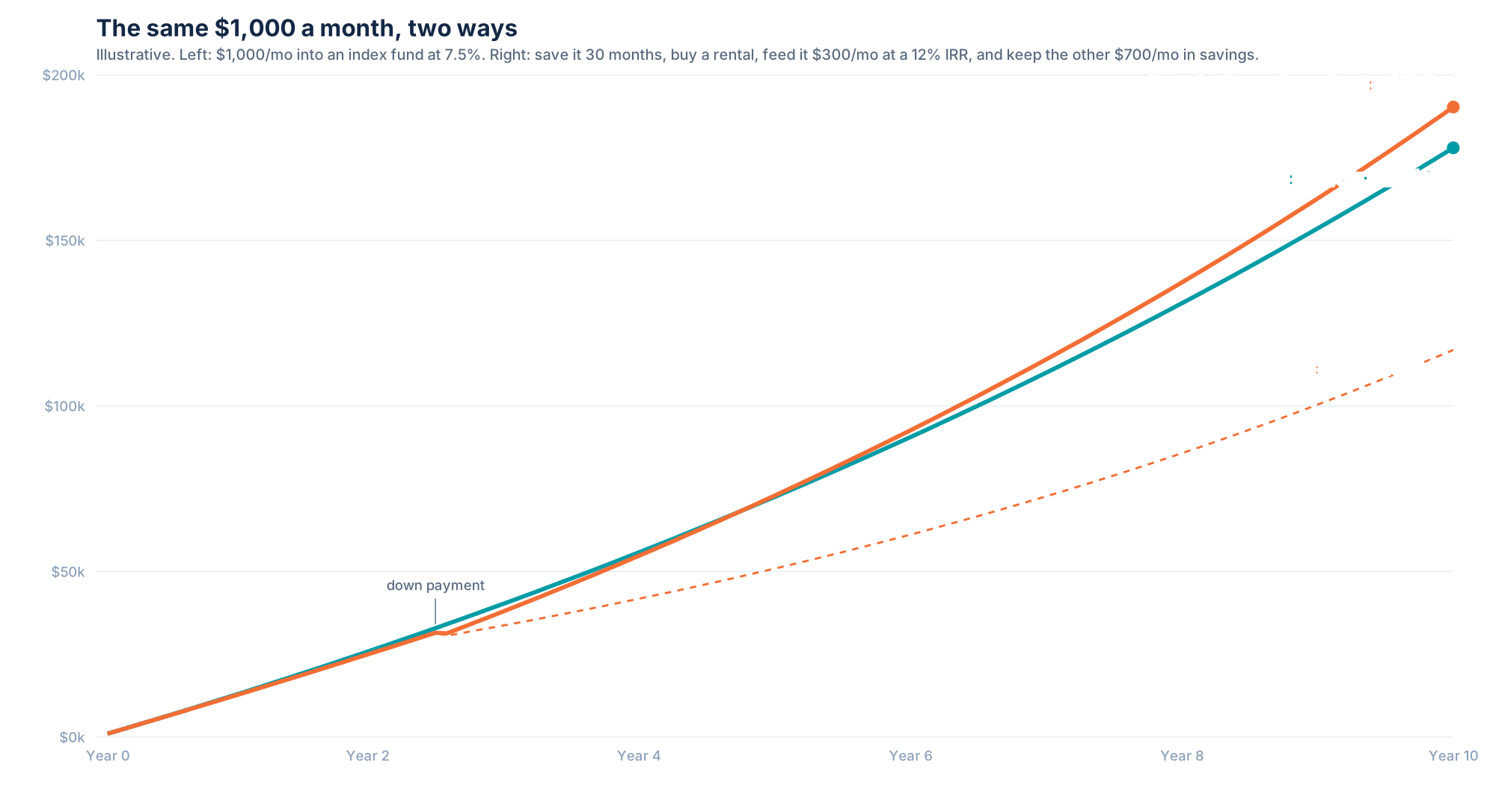 Same budget. The rental path ends a little ahead, and $73,000 of it is liquid.
The rental did that with less than half the money the fund needed. The rest never left your account.
And the rental sits on a lever the index fund doesn't have. Rents rise. Loans get refinanced. The $300 shortfall in year one is usually $0 by year four, and positive after that, and at that point the "contribution" stops and the asset keeps growing on its own.
When negative cash flow actually is a problem
I'm not telling you negative cash flow is fine. I'm telling you it's a contribution, and contributions have rules.
It's a problem when there's no margin. If the $300 a month is the difference between making rent on your own place or not, you don't have an investment, you have a stress test. The contribution has to be money you'd have put somewhere anyway.
It's a problem when there are no reserves. The HVAC is going to fail. The roof is on a clock. A rental with negative cash flow and no reserve plan is one surprise away from a forced sale, and forced sales are where the returns die.
It's a problem when there's no path to positive. If the plan is "it loses $300 a month forever," that's not a plan, that's a hobby. There should be a month, on a calendar, where the rent raise or the refinance or the payoff turns the number green.
And it's a problem when the deal is weak on the other three lines too. Negative cash flow on a property in a flat market with no equity growth and no tax benefit is just negative. The contribution only makes sense because the whole return clears your bar.
How to tell which case you're in
This is the part the spreadsheet never did for anyone, and the reason we built the product the way we did.
The Verdict tells you, before you buy, whether the deal clears your financial floors and how it stacks up against its own market, and it says the sentence that matters out loud: projected to beat the S&P 500 by $X through 2036, or not.

The Investment Plan is where you lay out the life of the thing: the loans, the refinance in year three, the HVAC in year two, the sale. It shows you the month the shortfall ends. If there isn't one, you'll see that too, and you should walk.
 The plan for one house: two loans, a refinance in year three, the HVAC and the fence on the calendar.
And once you own it, Portfolio Insights shows the year the way it actually went: cash flow next to value gained, loan paid down, and tax benefit. A year that felt like a loss on the bank statement reads as wealth gained, with every dollar accounted for.
Negative cash flow isn't the thing to be afraid of. Not knowing what the other three are doing is.
See it with your own numbers.
Search free with no signup, or start a 14-day free trial of Property Suite Pro.
Search listings